

Official Manuscript Submission Template & Formatting Guide
All research submissions to IJCSDI must adhere to our standardized academic typography, exact font size hierarchy, first-page left/footnote metadata, and high-resolution figure standards. Download the official pre-formatted templates below.
Master Typography & Font Size Specifications
Complete list of exact font sizes, styles, and alignments required across every section of the manuscript.
| Document Element | Font Family | Font Size | Font Style / Weight | Alignment & Spacing |
|---|---|---|---|---|
| Manuscript Title | Times New Roman | 18 pt | Bold (Title Case) | Centered, 12pt space after |
| Author Names | Times New Roman | 11 pt | Bold | Centered, Superscript numbers (e.g. 1,*, 2, 3) |
| Author Affiliations | Times New Roman | 9 pt | Italics | Centered, Department & University |
| Corresponding Author & ORCID | Times New Roman | 8.5 pt | Regular (Email highlighted) | Centered, 12pt space after |
| Abstract Heading & Body | Times New Roman | 9.5 pt / 10 pt | Abstract— Bold, Body Regular | Justified on both sides (flush on left and right margins) |
| Keywords | Times New Roman | 9.5 pt | Keywords— Bold, List Italics | Justified on both sides (4–6 terms separated by semicolons) |
| Level 1 Heading (e.g. 4. Results) | Times New Roman | 12 pt | Bold | Left-aligned, 12pt before, 6pt after |
| Level 2 Subsection (e.g. 4.1 Datasets) | Times New Roman | 11 pt | Bold | Left-aligned, 9pt before, 4pt after |
| Level 3 Sub-subsection (e.g. 4.1.1 Scaling) | Times New Roman | 10 pt | Bold-Italic | Left-aligned, 6pt before, 3pt after |
| Main Body Paragraphs | Times New Roman | 10 pt | Regular | Justified on both sides (flush on both margins), 1.15 line spacing, 6pt space after |
| Mathematical Equations | Cambria Math / Times | 10 pt | Italics (Math symbols) | Centered equation, Right-aligned number (1) |
| Figure Caption (BELOW figure) | Times New Roman | 9 pt | Figure 1: Bold, description Italic | Justified on both sides (or centered if single line), below graphic |
| Table Caption (ABOVE table) | Times New Roman | 9 pt | TABLE I: Bold Title | Centered strictly above table |
| Table Body & Cells | Times New Roman / Arial | 8.5 pt | Headers Bold, Data Regular | Horizontal booktabs borders only |
| First-Page Footnote Matter (Left) | Times New Roman | 8 pt / 7.5 pt | Regular & Bold labels | Justified on both sides, separated by solid divider line |
| Reference Items | Times New Roman | 8.5 pt | Regular, IEEE numbered [1] | Justified on both sides, Single spacing, 3pt space after |
| Running Header & Footer | Times New Roman | 8 pt | Regular / Italics | Both Left & Right justified on page edges |
First-Page Left-Side / Footnote Matter & Running Header/Footer
Standard peer-reviewed layout requirements for manuscript history, grants, licensing, and running headers.
In the template, a solid horizontal line separates the main text from the first-page metadata. Authors and editorial staff include:
Manuscript History: Received September 01, 2026; revised September 15, 2026; accepted October 01, 2026. Date of publication October 10, 2026.
Digital Object Identifier: DOI: 10.5555/IJCSDI.2026.XXXX | Open Access.
Funding & Grants: This research was supported in part by the National Science Research Foundation under Grant No. NCSP-2026-09.
Corresponding Author: First Author Name (e-mail: author@university.edu). Affiliation: Dept. of Computer Science, University, Country (ORCID: 0000-0002-1825-0097).
Open Access License: Creative Commons Attribution 4.0 International (CC BY 4.0).
Every page features standardized running headers and footers positioned across the left and right margins:
Section Numbering & Inner Subsections Hierarchy (4.1 & 4.1.1)
Authors must follow a strict three-tier numbering scheme to organize complex theoretical and experimental research clearly.
4. Experimental Setup & Results
Formatting: 12pt Bold, Primary Sections (1., 2., 3., 4., etc.). Top division for major components.
LaTeX: \section{...}
4.1 Benchmark Datasets & Preprocessing
Formatting: 11pt Bold, Secondary Subsections (4.1, 4.2, 3.1, etc.). Used to divide sections into targeted topics.
LaTeX: \subsection{...}
4.1.1 Feature Normalization & Scaling
Formatting: 10pt Bold-Italic, Tertiary Divisions (4.1.1, 4.1.2, etc.). For granular details, algorithms, or specific setups.
LaTeX: \subsubsection{...}
Figure 1 Demonstration & Artwork Quality Standards
All graphical diagrams, architectures, flowcharts, and plots must comply with international scholarly reproduction standards.
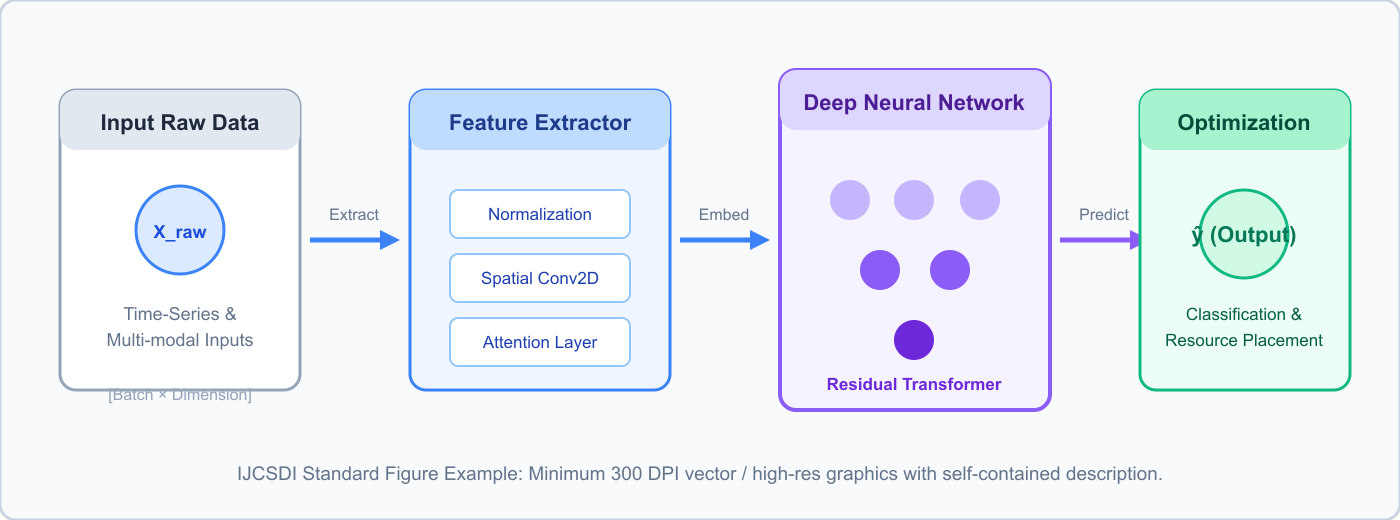
Graphics must be crisp vector format (PDF/EPS/SVG) or high-res raster (PNG/TIFF). Low-resolution, pixelated screenshots will be rejected during desk screening.
Figure captions must ALWAYS appear below the image (9pt Regular). In contrast, table captions must appear above tables (9pt Bold).
Every figure must be explicitly cited in the body text prior to or alongside its visual appearance (e.g. "As depicted in Figure 1..." or "see Fig. 1").
Text labels, axes, and legends inside the graphic must use clean sans-serif font (Arial/Helvetica) sized between 8pt and 10pt so all text remains readable.
Required Manuscript Sections & Headings Overview
Manuscripts should be organized logically according to standard IMRAD format:
1. Introduction [12pt Bold]
Establish background, research problem, motivations, and industrial/academic relevance. Conclude Section 1 with a bulleted list of novel technical contributions and a brief roadmap of the paper organization.
2. Related Work & Theoretical Foundations [12pt Bold]
Systematic critical synthesis of existing methodologies published in top venues within the last 3–5 years. Clearly articulate why prior techniques fall short and how the proposed method resolves these bottlenecks.
3. System Architecture & Proposed Methodology [12pt Bold]
Rigorous formalization: mathematical formulations, system diagrams, pseudocode algorithms, and data processing pipelines. All equations must be consecutively numbered (1), (2), etc.
4. Experimental Setup & Performance Evaluation [12pt Bold]
Hardware & software environment setup, datasets utilized, train/validation splits, evaluation metrics, baseline models, and ablation studies. Tables and figures must have informative captions.
5. Discussion & Limitations [12pt Bold]
Interpretation of experimental findings, practical implications, edge cases, scalability limitations, and computational trade-offs.
6. Conclusion & Future Work [12pt Bold]
Succinct summary of key findings and recommendations for future investigations.
Instant Template Downloads
Mandatory Declarations Text
Every paper submitted must include these 4 standardized declaration statements before the References section:
Declarations & Compliance Statements:
1. Conflict of Interest: The authors declare that they have no known competing financial interests or personal relationships that could have appeared to influence the work reported in this paper.
2. Funding Statement: This research did not receive any specific grant from funding agencies in the public, commercial, or not-for-profit sectors (or cite Grant No. XYZ123).
3. Data & Code Availability: The datasets and source code generated or analyzed during this study are available in the public repository at https://github.com/author/project (or available upon reasonable request).
4. Generative AI Disclosure: No generative artificial intelligence technologies were used in the substantive drafting, analysis, or creation of figures for this manuscript.
Pre-Submission Checklist
- All author names, affiliations, and ORCID iDs verified.
- Abstract is within the 150–250 word count limit.
- Figures are 300+ DPI with captions strictly placed below.
- Turnitin similarity is strictly below the 15% threshold.